Loading...

Optimized Strategies for Customer Acquisition

by Theresa Nguyen 6 min read December 19, 2023

While today’s consumers expect a smooth, frictionless digital experience, many financial institutions still rely on outdated technology and manual reviews to acquire new customers. These old processes can prevent lenders from making accurate and timely credit decisions, leading to lost opportunities, revenue, and goodwill.

By optimizing their customer acquisition strategies, financial institutions can allocate their resources effectively and say yes to consumers faster. This guide will walk you through the current challenges facing customer acquisition and how robust optimization strategies can help.

Current challenges in customer acquisition

To stay competitive and engage high-value customers, you’ll need an efficient customer acquisition process that weeds out both fraudulent actors and risky consumers. However, achieving this balancing act comes with a unique set of challenges.

Because today’s consumers can access goods and services almost anywhere online at any time, more than 54 percent of customers expect a heightened digital and frictionless experience. Failing to meet this expectation can lead to huge losses for lenders.

Some of the most common challenges in customer acquisition include:

  • Although 52 percent of consumers prefer digital banking options over visiting branches in person, many lenders still rely on paper documents, which can add weeks to the onboarding process.
  • Requiring consumers to provide substantial information about themselves during an application process can lead to abandoned applications. 67 percent of consumers will leave an application if they experience complications.
  • Verifying consumer identities is growing increasingly important. In fact, about 35 percent of customers drop out of digital onboarding because their identity can’t be confirmed.
  • Poorly defined campaign planning can cause businesses to market to the wrong population segments, resulting in wasted time and resources.

What is optimization for customer acquisition? 

Customer acquisition optimization is the process of implementing new methods and solutions to make acquiring new customers more efficient and cost-effective. For lenders, this means streamlining steps in the credit decisioning process to focus on the right prospects and reduce friction.

What types of processes can be optimized for customer acquisition? 

You might be surprised just how many processes can be optimized for customer acquisition. Here are just a few examples:

  • Having a holistic view of consumers allows you to take the guesswork out of targeting so you can better identify and engage high-potential customers.
  • Utilizing predictive and lifestyle data enables you to pinpoint a more precisely segmented audience for marketing.
  • Digital application solutions that reach across multiple channels, allowing applicants to leave one channel and pick up right where they left off in another.
  • Real-time identity verification and fraud detection during onboarding and after, helping expedite approvals and mitigate risks.
  • Utilizing API integration to leverage multiple metrics beyond credit scores when screening applicants’ financial situation.
  • Building custom risk models that pair to your existing data so you can say yes to more customers and better manage portfolio risk.

Benefits of customer acquisition optimization

Optimization can bring numerous benefits to your business, providing a faster return on investment. Here are some examples.

  • By better pinpointing your marketing through predictive and lifestyle data, you can achieve increased conversions.
  • Faster onboarding with less friction helps retain more customers.
  • Real-time fraud detection and identity verification reduce customer roadblocks, allowing you to realize significant growth.
  • Custom risk models and decisioning platforms can pair your data with additional data elements, providing more than just a credit score rating for your applicants. This can help you say yes to more customers.
  • Using AI and machine learning tools will reduce the need for manual reviews and thus increase booking rates and applications.

A real-life example of these benefits can be found with the Michigan State University Federal Credit Union (MSUFCU.) With over $7.2 billion in assets and 330,000 members, the client was manually reviewing all its applications. Experian reviewed the client’s risk levels and approvals, comparing their risk and bankruptcy scores to determine which were most predictive. This analysis led Experian to recommend a new decisioning platform (Experian Decisioning) for instant credit decisions, an alternative data score tool, and Experian Advisory Services for risk-based pricing. After implementing these optimization solutions, MSUFCU saw a 55 percent increase in average monthly automations, four times improved online application response time and began competing more effectively in the marketplace.

How Experian can help

Experian offers a number of customer acquisition tools, allowing companies to be more responsive in an increasingly competitive market, while still reducing fraud risk. These tools include:

Acquisition optimization marketing

Experian offers a web-based platform that lets clients manage their marketing efforts all in the same place. You can upload and enhance client files, identify lookalike prospects, and use firmographic and credit data to get a holistic view of your clients and your prospects.

Data-driven acquisition and decisioning engine

Experian Decisioning is a data-driven decisioning engine that accepts applications from multiple channels, automates data collection and verification and proactively monitors decision results. It’s flexible enough to reach across multiple channels, letting customers set aside their application in one digital channel and resume where they left off in another. It also provides businesses with access to comprehensive data assets, proactive monitoring and streamlined development with minimal coding.

Enhanced fraud detection and identity verification

Experian’s Precise ID® is a risk-based fraud detection and prevention platform that provides analytics to accurately verify customers and mitigate fraud loss behind the scenes, ensuring a smoother onboarding process.

Robust consumer attributes for better customized models

Experian gives clients access to a wider berth of consumer attributes, helping you better screen applicants beyond just looking at credit scores.

Trended 3DTM attributes let you uncover unique patterns in consumers’ behavior over time, allowing you to manage portfolio risk, build better models and determine the next best actions.

Premier AttributesSM aggregates credit data at the most granular and meaningful levels to provide clear insights into consumer credit behavior. It encompasses more than 2,100 attributes across 51 industries to help you develop highly predictive custom models.

Enterprise-wide credit decisioning engine

Experian’s enterprise-wide credit decision platform lets you combine machine learning with proprietary data to return optimized decisions and quickly respond to requests. Robust credit decisioning software lets you convert data into meaningful actions and strategies.

With Experian’s machine learning decisioning options, companies are realizing a 25 percent reduction in manual reviews, a 25 percent increase in loan and credit applications and a 26 percent increase in booking rates.

Highly predictive custom models

Experian’s Ascend Intelligence ServicesTM can help you create highly predictive custom models that create sophisticated decisioning strategies, allowing you to accurately predict risk and make the best decisions fast. This end-to-end suite of solutions lets you achieve a more granular view of every application and grow portfolios while still minimizing risk.

Experian can help optimize your customer acquisition

Experian provides a suite of decisioning engines, consumer attributes and customized modeling to help you optimize your customer acquisition process. These tools allow businesses to better target their marketing efforts, streamline their onboarding with less friction and improve their fraud detection and mitigation efforts. The combination can deliver a powerful ROI.

Learn more about Experian’s customer acquisition solutions.
Related Posts

Leverage financial wellness and identity protection products and turn them into high-engagement experiences that drive revenue.

by Laura Burrows 6 min read April 3, 2026

A new reality for screening providers Everything about the candidate checked out. Their resume reflected the right experience. Their references confirmed it. The background screening process came back clean. From outside, there was no reason to hesitate. So, the company didn’t.  But within weeks, small inconsistencies began to surface. The employee struggled in ways that didn’t match their credentials. Follow-up questions led to vague answers. Eventually, a deeper review uncovered the issue; this wasn’t just a case of exaggeration. It was candidate fraud. And increasingly, it’s not just individuals acting alone.  In a widely reported scheme, foreign operatives posed as legitimate remote IT workers, using stolen identities and AI-assisted interviews to secure jobs at major Fortune 500 companies. Once hired, access was handed off, allowing bad actors to infiltrate corporate systems and generate millions in illicit revenue. In one case, a single individual funneled over $17 million to a foreign operation. These weren’t obvious scams. The candidates passed interviews. They cleared checks. And that’s exactly the point. For background screening and verification providers, this shift presents both a challenge and an opportunity. As candidate fraud becomes more sophisticated, your clients are no longer just looking to verify records – they’re looking to trust identity itself, and they’re looking to you to help them do it. The assumption that no longer holds For decades, hiring has relied on a simple premise: verify the records, resume, and you can trust the candidate. That model worked when identity was easier to validate in person. But in today’s digital-first hiring environment, identity can oftentimes be asserted, not proven. At the same time, identity-based fraud is accelerating. Synthetic identity fraud alone accounts for billions in annual losses, and employers are increasingly encountering candidates whose identities are far more difficult to validate than their resumes. This creates a critical disconnect: Organizations are still verifying records, but those records may be tied to identities that were never legitimate to begin with. Increasingly, they’re turning to their screening partners to close that gap. The reality of candidate fraud 31% of employers have interviewed candidates using a false identity Only 19% feel confident they can detect fraud in hiring 1 in 4 companies report losses of$50K+from fraudulent hires Why candidate fraud is getting harder to see The nature of candidate fraud has fundamentally changed. At one end of the spectrum, companies are still dealing with candidates who falsify resumes, costing businesses time and money when the truth comes to light later. But at the other end, the threat has escalated dramatically. Coordinated fraud rings are now using stolen identities and AI-assisted interviews to place individuals into remote roles, sometimes without ever revealing their identity. And this isn’t slowing down. According to Gartner, by 2028, 1 in 4 candidates could be fake, driven by AI, remote hiring, and identity manipulation. For screening providers, this introduces a new level of complexity. The challenge is no longer just delivering verified records; it’s helping clients surface risks that traditional screening processes were not designed to identify. What traditional screening still gets right None of this diminishes the importance of pre-employment screening. Verifying employment history, education, and background remains a critical part of responsible hiring, and it should. But even the most thorough screening process is designed to answer a specific question: Do the records align with the identity provided? What it does not answer is the question that matters most now: Is that identity real? That gap between record verification and identity validation is where modern fraud operates. And it represents an opportunity for screeners to expand their role from record validation to helping enable stronger identity confidence. The cost of believing everything is working When fraud moves through the hiring process undetected, the consequences aren’t always immediate, but they can be significant. There are financial risks, compliance exposure and potential access to sensitive systems. But there’s also a more subtle —and often overlooked — impact: The assumption that existing processes are working as intended. When fraudulent candidates pass through screening, it reinforces confidence in processes that may not be equipped for today’s threat landscape. Over time, that false sense of security can become a vulnerability. From screening provider to strategic partner As hiring evolves, so do expectations. Employers are no longer just looking for faster background checks - they’re looking for greater confidence in who they’re hiring. This shift creates an opportunity for screening providers to move upstream in the hiring process. By introducing identity verification earlier in the workflow, providers can help clients detect candidate fraud sooner, reduce downstream risk, and strengthen the integrity of hiring decisions.  More importantly, it allows providers to differentiate their offerings in an increasingly competitive market, shifting from a transactional service to a more strategic capability. A shift in thinking: Identity before everything else To address modern candidate fraud, organizations don’t just need better tools; they need a different starting point. Instead of beginning with records, leading providers are beginning with identity. They are asking a more fundamental question earlier in the process:  Is this person who they say they are? Is this person a real, consistent and verifiable person? When that foundation is established, everything that follows becomes more meaningful. Background checks become more reliable. Verification becomes more consistent. And the ability to detect candidate fraud improves, not because the process is longer, but because it’s more informed. In this model, identifying potential fraud becomes proactive rather than reactive. Why identity verification matters more now than ever The shift to remote and digital hiring hasn’t just changed how companies hire – it’s changed how fraud occurs. Today, a significant portion of fraudulent activity targets the employment process, making it a key point of exposure for identity misuse. In fact, 45% of all false document submissions now occur in the employment sector. In many cases, candidates who falsify information still progress through hiring workflows. A study revealed that 70% of candidates who falsify information still get hired. This reinforces today’s reality: Fraud is no longer slipping through the cracks; it’s moving through the front door. How Experian helps close the identity gap Experian® helps background screeners and verification providers bridge the gap between who a candidate claims to be and who they are. By combining identity verification, fraud detection, and verification solutions, Experian enables providers to enhance their existing solutions – without disrupting their workflows. This allows you to extend your value beyond traditional screening, help clients detect candidate fraud earlier, and strengthen confidence in hiring outcomes.   The result is not just better screening, it’s a stronger strategic position in your clients’ hiring ecosystem, one that reduces risk while improving speed and confidence. Candidate fraud isn’t an edge case anymore. It reflects a broader shift in how identity works in a digital world. And while traditional screening remains essential, it may not be sufficient on its own. Because if identity is uncertain, every subsequent check is built on unstable ground. But when identity is established earlier in the process, everything that follows becomes more dependable. Don’t just verify the candidate records, verify the identityLearn how Experian helps screening providers embed identity verification at the start of the hiring journey to help detect candidate fraud earlier, reduce risk, and strengthen screening outcomes.  Explore Experian’s Fraud Prevention Playbook for Pre-Employment Screening FAQs

by Kim Le 6 min read March 26, 2026

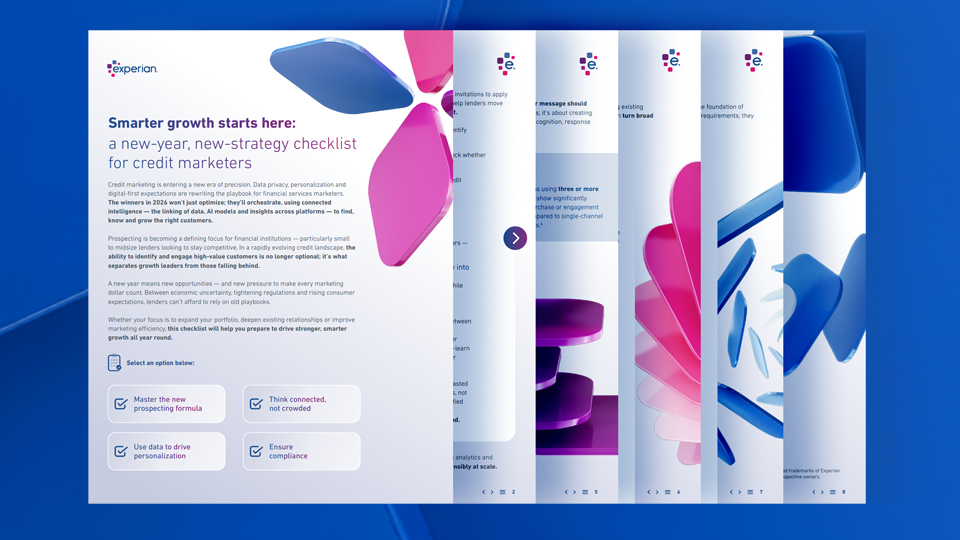
Explore strategies to drive smarter acquisitions, deepen existing relationships and improve marketing efficiency.

by Theresa Nguyen 6 min read December 18, 2025

Subscribe to our thought leadership

Enter your name and email for the latest updates.

This site is protected by reCAPTCHA and the Google Privacy Policy and Terms of Service apply.

Subscribe to our thought leadership

Don't miss out on the latest industry trends and insights!
Subscribe